hygiene-precision: distributor of Aquolab products




Dentures: poor cleaning increases the risk of pneumonia
Find out why poorly cleaned dentures increase the risk of pneumonia and how the Aquolab ozone dental jet improves oral hygiene.
hygiene-precision.com
3/2/20269 min read
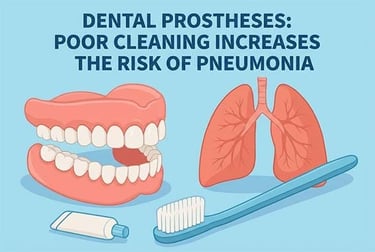
Poorly Cleaned Dental Prostheses Increase the Risk of Lung Infections
Dental prostheses including full dentures, partial dentures, and removable bridges restore comfort, aesthetics, and chewing function. However, their maintenance is often neglected. Recent studies show that inadequate denture hygiene can significantly increase the risk of pneumonia, particularly in older adults.
Indeed, a poorly cleaned dental prosthesis can become a true microbial reservoir. This article explores the underlying mechanisms, the infection risks involved, and presents a complete oral hygiene routine incorporating Aquolab innovations: the ozone dental irrigator, Ozonic toothpaste, and the sonic toothbrush.
Why Poorly Cleaned Dental Prostheses Can Promote Pneumonia
Biofilm: a true breeding ground for bacteria
Dental prostheses rapidly accumulate a polymicrobial biofilm composed of bacteria and fungi. These microorganisms colonize resin surfaces and form a layer that is resistant to conventional rinsing.
Among them are pathogenic bacteria responsible for respiratory infections, such as Streptococcus pneumoniae, Staphylococcus aureus, Pseudomonas aeruginosa, and Haemophilus influenzae. When a prosthesis is not properly cleaned, these microorganisms multiply and increase the infectious load in the oral cavity.
Bacterial aspiration during sleep
In denture wearers, silent aspiration of saliva or contaminated secretions can lead to aspiration pneumonia.
A Japanese study demonstrated that sleeping with dentures doubles the risk of pneumonia. The reason: bacteria present on the prosthesis migrate into the respiratory tract during sleep, especially in older adults whose cough reflex is weakened.
Other aggravating factors
Prolonged nighttime denture wear
Insufficient oral hygiene
Denture-related stomatitis (Candida albicans)
Weakened immune system
Neurological disorders or swallowing difficulties
All these factors increase the risk of denture-related infections and, consequently, pulmonary complications.
Scientific Evidence Confirms the Link Between Dental Prostheses and Pneumonia
Epidemiological studies
Research shows a significant correlation between poor denture hygiene and pneumonia:
Iinuma et al., 2015: Older adults who slept with their dentures had a 2.3-fold higher risk of pneumonia.
Shimizu et al., 2019: Irregular denture cleaning increased the risk of lung infection by 30%.
Sumi et al., 2002 / 2012: In nursing homes, improved oral hygiene (daily denture cleaning) reduced the incidence of nosocomial pneumonia.
These findings demonstrate that pneumonia risk is largely modifiable through the quality of oral and denture hygiene.
Risks of Complications Associated with Poorly Maintained Dentures
Inadequate denture care does not only increase pulmonary risk. It can also lead to:
Stomatitis and oral candidiasis: painful mucosal inflammation caused by Candida albicans
Mucosal irritation and lesions due to plaque and debris accumulation
Premature wear of prosthetic materials
Increased systemic risk (chronic inflammation, circulating bacteria)
A poorly maintained dental prosthesis therefore becomes a global health risk factor.
How to Clean Removable Dental Prostheses
Cleaning the prosthesis alone is not sufficient. The entire oral cavity (tongue, gums, palate) must be cleaned regularly to reduce the microbial reservoir. Below are the recommended steps for proper denture hygiene:
Essential daily routine
Remove the denture at night: avoiding nighttime wear drastically reduces the risk of microbial aspiration.
Mechanically clean the denture: gentle brushing with lukewarm water using a specific brush and neutral soap.
Soak the denture in an appropriate disinfecting solution (chlorine-free).
Brush the tongue and gums to limit bacterial proliferation.
Rinse thoroughly before reinserting the denture.
A rigorous routine helps reduce prosthetic complications and respiratory infections.
Cleaning and Maintaining Fixed or Removable Dental Prostheses with Aquolab Products
Aquolab solutions combine mechanical effectiveness with natural disinfection through ozone, a powerful natural oxidant with antibacterial, antifungal, and antiviral properties.
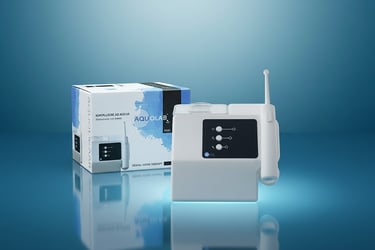
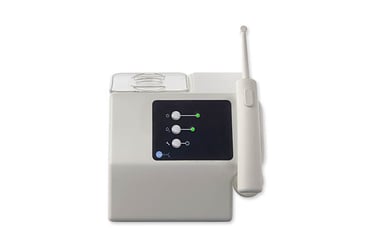
The Aquolab Ozone Dental Irrigator
The Aquolab ozone dental irrigator combines mechanical action (pulsed water jet) with a gentle oxidizing effect (ozone).
It thoroughly cleans and disinfects hard-to-reach areas: beneath dentures, interdental spaces, and the gingival margin. Suitable for all fixed and removable dental appliances.
Benefits:
Reduction of biofilm and bacterial load
Prevention of infections and inflammation
Non-abrasive action, gentle on oral tissues
Ozone, used at controlled concentrations, acts as a natural disinfectant without irritating oral tissues. It promotes tissue oxygenation and remineralization.
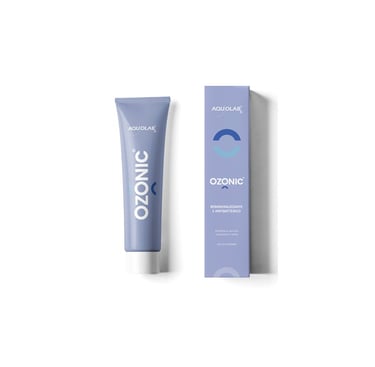
Aquolab Ozonic Ozone Toothpaste
Ozonic toothpaste incorporates the benefits of ozone in a gentle, protective formula based on olive oil and sage.
It eliminates odor-causing bacteria, reduces inflammation, and supports a healthy balance of oral flora. It is remineralizing thanks to its natural hydroxyapatite composition. Ozone is a powerful natural disinfectant.
Benefits:
Natural antibacterial action
Non-aggressive cleaning
Reduced risk of infection around dental prostheses
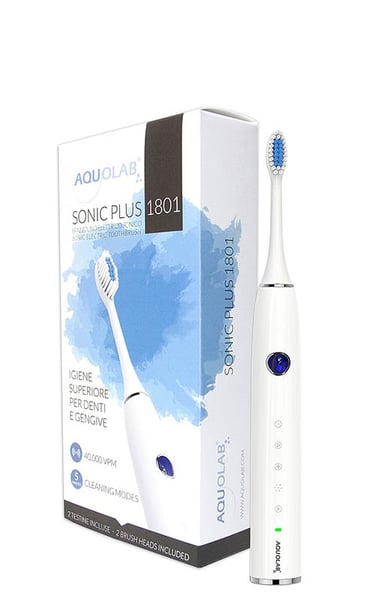
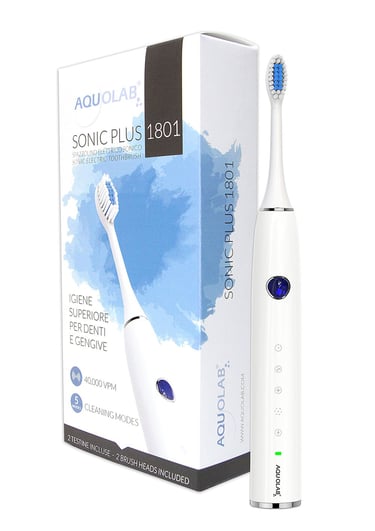
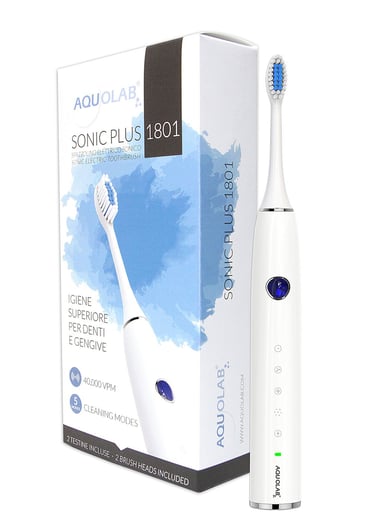
The Aquolab Sonic Toothbrush
The Aquolab sonic toothbrush uses high-frequency vibrations to dislodge biofilms. Its vertical high-frequency motion creates microbubbles of toothpaste and oxygen, ideal for deep cleaning of the oral cavity.
It is particularly suitable for partial or fixed denture wearers and for older adults with limited manual dexterity.
Benefits:
Thorough yet gentle cleaning
Gingival massage that stimulates circulation
Perfect synergy with Ozonic toothpaste
Complete Oral–Prosthetic Hygiene Routine with Aquolab
Remove and rinse the denture.
Brush teeth, tongue, and gums using the Aquolab sonic toothbrush and Ozonic toothpaste.
Use the ozone dental irrigator to reach difficult areas.
Clean the denture separately, then soak it in an appropriate solution.
Remove the denture at night to limit respiratory contamination.
This combination provides optimal denture hygiene, reduces infection risk, and improves daily oral comfort.
Practical Tips to Prevent Infections
Never sleep with your dentures.
Clean both the denture and the mouth daily.
Avoid abrasive or chlorinated products.
Regularly check denture fit with your dentist.
Educate caregivers and healthcare providers on proper denture hygiene.
Integrate modern tools (sonic toothbrush, ozone irrigator, Ozonic toothpaste).
Good oral–prosthetic hygiene directly contributes to the prevention of respiratory infections.
Conclusion
Poorly cleaned dental prostheses are not inert objects: they can become active microbial reservoirs responsible for aspiration pneumonia, particularly in older adults. Fortunately, pneumonia risk is reversible through rigorous hygiene and the use of innovative tools such as those offered by Aquolab: the ozone dental irrigator, Ozonic toothpaste, and the Aquolab sonic toothbrush. By integrating these devices into a daily routine, denture wearers can significantly reduce infection risk and preserve both respiratory and oral health.
Scientific References
Iinuma T. et al. (2015). Denture wearing during sleep doubles the risk of pneumonia in the very elderly. J Dent Res, 94(3 Suppl):28S–36S.
https://pmc.ncbi.nlm.nih.gov/articles/PMC4541085/Sumi Y. et al. (2002). Oral care may reduce pneumonia in the elderly. J Am Geriatr Soc, 50(3):430–433.
https://pubmed.ncbi.nlm.nih.gov/11943045/Maciel J. et al. (2024). Ill Effects and Complications Associated to Removable Dentures with Improper Use and Poor Oral Hygiene. Am J Dent.
https://www.amjdent.com/Archive/ReviewArticles/2024/Maciel%20AJD%20Dec%202024.pdfKhan S. et al. (2022). Complications Associated to Poor Oral Hygiene in Denture Wearers: A Systematic Review. ResearchGate.
https://www.researchgate.net/publication/362785011Okuda K. et al. (2005). Biofilm formation on denture materials and pneumonia risk. Clin Infect Dis, 40(12):1807–1810.
https://academic.oup.com/cid/article/40/12/1807/314357Sumi Y. et al. (2012). Oral biofilm and pneumonia in institutionalized elderly. J Dent Res, 91(9):831–838.
https://journals.sagepub.com/doi/10.1177/0022034512450034Shimizu K. et al. (2019). Impact of oral hygiene on respiratory infections among the elderly. Sci Rep, 9:50129.
https://www.nature.com/articles/s41598-019-50129-9MDPI Journal of Clinical Medicine (2023). Association between denture hygiene and pneumonia in older adults.
https://www.mdpi.com/2077-0383/12/19/6127BMC Oral Health (2024). Oral hygiene and pneumonia in nursing home residents.
https://bmcoralhealth.biomedcentral.com/articles/10.1186/s12903-024-04814-5




Continue reading...
© 2024. All rights reserved.