hygiene-precision: distributor of Aquolab products





Interdental Brushes : Warning danger !
Interdental brushes are a complement to traditional brushing to remove plaque in interdental spaces. However, like any accessories, they have some drawbacks that should not be overlooked.
This article was written by the Hygiène Précision team, based on scientific data and rigorous clinical studies. Updated on 14/09/2026
5/6/20266 min read


Interdental brushes have become an essential part of modern oral hygiene routines. Presented as an ideal complement to traditional toothbrushing, they promise precise cleaning between teeth. However, behind their apparent simplicity, these small tools can be harmful to gums if poorly chosen or improperly used.
In this article, we explore the dangers of interdental brushes for gum health, common mistakes to avoid, and gentler alternatives such as the ozone dental water flosser.
This article contains the following :
What is an interdental brush and what is it used for?
Interdental brushes are small cylindrical or conical brushes mounted on a thin handle. Their purpose is to remove food debris and dental plaque from spaces where a toothbrush cannot reach.
They come in various sizes and shapes, adapted to the morphology of each interdental space. Dentists often recommend them to help prevent gingivitis, periodontitis, and bad breath.
However, their use requires great precision. An ill-fitting interdental brush or one used with excessive force can damage delicate gum tissues and cause chronic pain.
Can interdental brushes damage gums?
Yes, interdental brushes can damage gums. Although they are known for their effectiveness, they are not without risks. Here are the four major dangers to be aware of before using them.
1. Incorrect size: the most common cause of gum injuries
One of the greatest dangers of interdental brushes lies in choosing the wrong size.
A brush that is too large exerts excessive pressure on the gums, causing micro-cuts, inflammation, and persistent bleeding.
Conversely, a brush that is too small will be ineffective, allowing plaque and bacteria to accumulate, which can eventually lead to cavities or periodontitis.
Tip: Always ask your dentist to measure your interdental spaces before purchasing interdental brushes.
2. Poor technique: an underestimated risk
The effectiveness of interdental brushes depends entirely on proper technique. Many people insert them forcefully, believing this will “clean better.” In reality, this action traumatizes gum tissues and can even damage tooth enamel.
Incorrect handling can also cause gum recession, making teeth more sensitive to heat and cold.
Tip: Insert the brush gently, using slow, horizontal movements without forcing it.
3. Hard-to-reach areas: a risk of chronic irritation
Certain areas of the mouth especially behind the molars, around implants, or near bridges are more difficult to access.
Using an interdental brush at the wrong angle in these areas can lead to repeated trauma and chronic gum inflammation.
4. Repetitive cost: a neglected but real drawback
While not a physical danger, cost remains a long-term disadvantage. Interdental brushes must be replaced weekly or after extended use.
This sometimes encourages people to reuse worn brushes, whose deformed bristles become more aggressive to the gums.
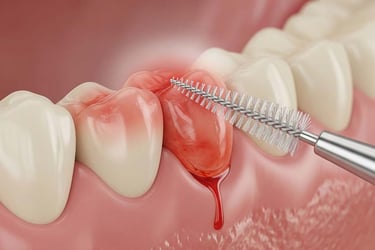
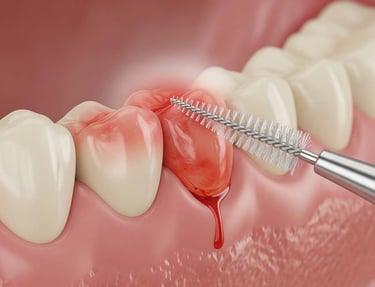
Interdental brushes bleeding
Gum bleeding after using interdental brushes is a warning sign.
While slight bleeding may be acceptable at the beginning (especially during first use), regular bleeding usually indicates tissue trauma or untreated inflammation.
Main causes of bleeding include :
A brush that is too large or too stiff
Excessive pressure during cleaning
Overuse (several times a day)
The presence of periodontal disease
Important: If bleeding persists for more than a few days, consult a dentist. Continuing to use interdental brushes despite pain often worsens the damage.
When should interdental brushes be avoided?
Certain situations require extra caution or complete avoidance of interdental brushes.
Cases where it is better to refrain :
Sensitive or painful gums: opt for very fine brushes or a water flosser
Periodontal problems: brushes may widen gum pockets
Presence of implants, crowns, or bridges: rigid contact can injure tissues around prosthetics
How to use an interdental brush safely?
To benefit from their advantages without harming your gums, follow these simple guidelines :
Choose the correct size (professional advice is essential)
Insert the brush gently, always at a right angle
Use soft back-and-forth movements without twisting
Rinse the brush thoroughly after use
Replace it regularly, especially if the bristles are bent
What is a safe alternative to interdental brushes?
If you suffer from sensitive gums, an ozone water flosser is an ideal alternative.
This device delivers a controlled pressurized water jet enriched with ozone, cleaning interdental spaces without aggressive contact with the gums.
Benefits of the ozone dental water flosser :
Deep cleaning with no risk of injury
Natural disinfection thanks to ozone
Improved oxygenation and gum tissue health
Perfectly suitable for implants, bridges, braces, and orthodontic appliances
Eliminates bacteria responsible for dental plaque
Promotes remineralization
An eco-friendly and sustainable alternative to disposable interdental brushes

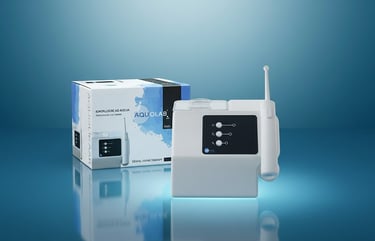
This chart clearly illustrates that ozone water flossers are a gentler and safer alternative to interdental brushes, especially for people prone to gum inflammation.
Water flosser or interdental brushes?
Interdental brushes
Interdental brushes are commonly recommended for cleaning between teeth because they effectively remove plaque and food debris. However, their use is not without risks. An unsuitable brush (too large, bristles too stiff) or improper insertion technique can lead to gum damage, such as irritation, repeated bleeding, or inflammation, and weaken gum tissue in the long term.
The oral irrigator
Also called a water flosser, it offers a safer, complementary, or replacement alternative. It cleans interdental spaces with a pulsed jet of water, without direct contact with the gums. This method minimizes mechanical trauma and allows for regular cleaning, particularly for people with sensitive gums, implants, bridges, or orthodontic appliances. The water flosser thus helps reduce bacterial load while being gentler on soft tissues, provided it is used with appropriate pressure, such as those manufactured by Aquolab. The addition of ozone to the water, like an ozone water flosser, reduces pressure and increases the elimination of bacteria responsible for oral infections.
For the health of your gums, opt for a water jet, which has controlled pressure, rather than interdental brushes.


Can interdental brushes remove tartar?
Interdental brushes are excellent for removing plaque and food debris from between your teeth, helping to prevent tartar from forming. However, they cannot remove hardened tartar (calculus) once it has built up on the teeth. Tartar must be removed by a dental professional during a scaling or cleaning appointment. Using interdental brushes daily, along with regular brushing and flossing, is one of the best ways to reduce plaque buildup and maintain healthy gums.
Interdental brush vs floss?
Both are useful, but they don't do exactly the same job.
Dental floss fits easily between very tightly packed teeth. It primarily removes plaque stuck at the point of contact between the teeth.
Interdental brushes clean wider spaces, implants, bridges, orthodontic appliances, or areas where the gums have receded more effectively. They are often more efficient and easier to use correctly.
In practice:
teeth very close together → dental floss
small visible spaces between teeth → interdental brush
appliance / implant / bridge → interdental brush
Dentists often recommend using an interdental brush when it can be used without force. Both of these devices must be handled with care as they can injure your gums. This is where the Aquolab water flosser provides a painless alternative for cleaning between teeth.
In summary : interdental brushes are useful but should be handled with care.
Interdental brushes are effective at removing plaque, but they can be harmful to the gums if they are the wrong size or if the technique used is too aggressive. Recurring bleeding, persistent pain, or inflammation should always be a cause for concern.
To preserve the health of your gums:
Choose your interdental brushes with the help of a dentist.
Never force it during insertion.



Continue reading...
© 2024. All rights reserved.